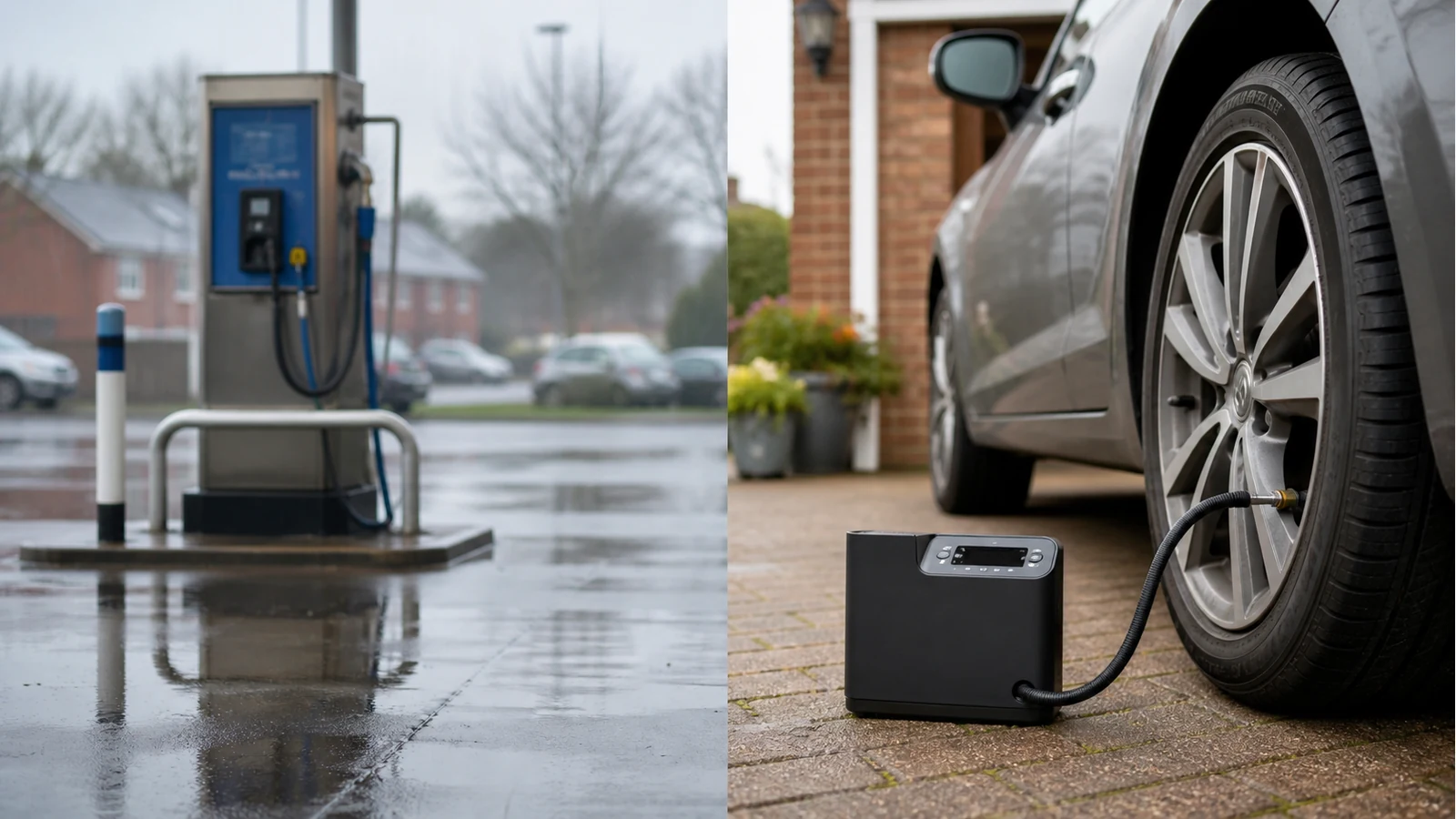
Petrol Station Air Vs Portable Tyre Inflator Uk
For an emergency top-up away from home, a petrol-station airline can be the quickest available option. For weekly cold driveway checks, a portable tyre inflator is usually more convenient because you can check before driving, avoid queues, and repeat the same routine. Accuracy still depends on the machine or gauge, so treat conflicting readings seriously.
Comparison table
| Question | Petrol-station air | Portable inflator |
|---|---|---|
| Cold check before journey | Harder, because you usually drive there first. | Easy on a driveway or garage floor. |
| Emergency availability | Useful if nearby and working. | Useful if it is in the boot and has the right power source. |
| Queue and time pressure | Can involve queues, payment and time limits. | You control the timing at home. |
| Gauge trust | Varies by site and machine condition. | Varies by model; verify with a gauge if readings conflict. |
| High-volume jobs | May be better for very large tyres or high-volume inflation. | Depends on the compressor capability and duty cycle. |
Cold pressure is the deciding factor
The Highway Code says tyre pressure should be checked before the journey, when tyres are cold, because warm tyres can give misleading readings. That single rule is why a home inflator can make sense: you can check before school run, commuting or a motorway trip rather than after driving to a forecourt.
Portable does not automatically mean accurate. Which? tests tyre inflators against a calibrated master gauge and reports that gauge accuracy varies by model. If your portable pump, handheld gauge and forecourt machine disagree by more than you expect, do not average them casually. Recheck cold with one known-good gauge or ask a tyre shop to verify.
When the forecourt still wins
Use the forecourt if you have a very low tyre and it is the nearest safe inflation point, if your own inflator cannot reach the required pressure, or if you need more airflow than a small portable unit can provide. Parkers notes the convenience of owning a compressor, but that does not make every portable unit right for every tyre.
When a portable inflator wins
A portable inflator is strongest for routine checks: family cars on a Sunday morning, a cold snap that triggers TPMS, or topping up before a long trip. A 12V model can work from the car socket; a mains model can work in the garage; a dual-power model can cover both if the cable reach and pressure capability match the job.
If your need is routine cold checks at home plus occasional road top-ups, the Oasser dual-power tyre inflator is a relevant same-site option to compare. Skip it if you need a workshop tank compressor, tyre fitting equipment, or a unit specified for heavy commercial use beyond its published limits.
Simple decision path
- Weekly cold checks at home: portable inflator plus a consistent gauge.
- Tyre already very flat away from home: nearest safe inflation or breakdown support.
- Readings conflict: stop guessing and verify with a trusted gauge.
- Large-volume or high-pressure use: check the compressor specification before buying.